Learn how CNC machining tolerances and stack-up affect product quality. Discover how material selection and precision equipment from Accura CNC Supply ensure manufacturing success.
CNC Machining Tolerance: Why 0.05mm Can Make or Break Your Product
In CNC machining, the gap between a successful product and a costly recall often comes down to a few microns. Whether you're producing aerospace components or medical devices, understanding tolerance isn't optional—it's the foundation of manufacturing precision.
Understanding CNC Machining Tolerances and Dimensional Accuracy
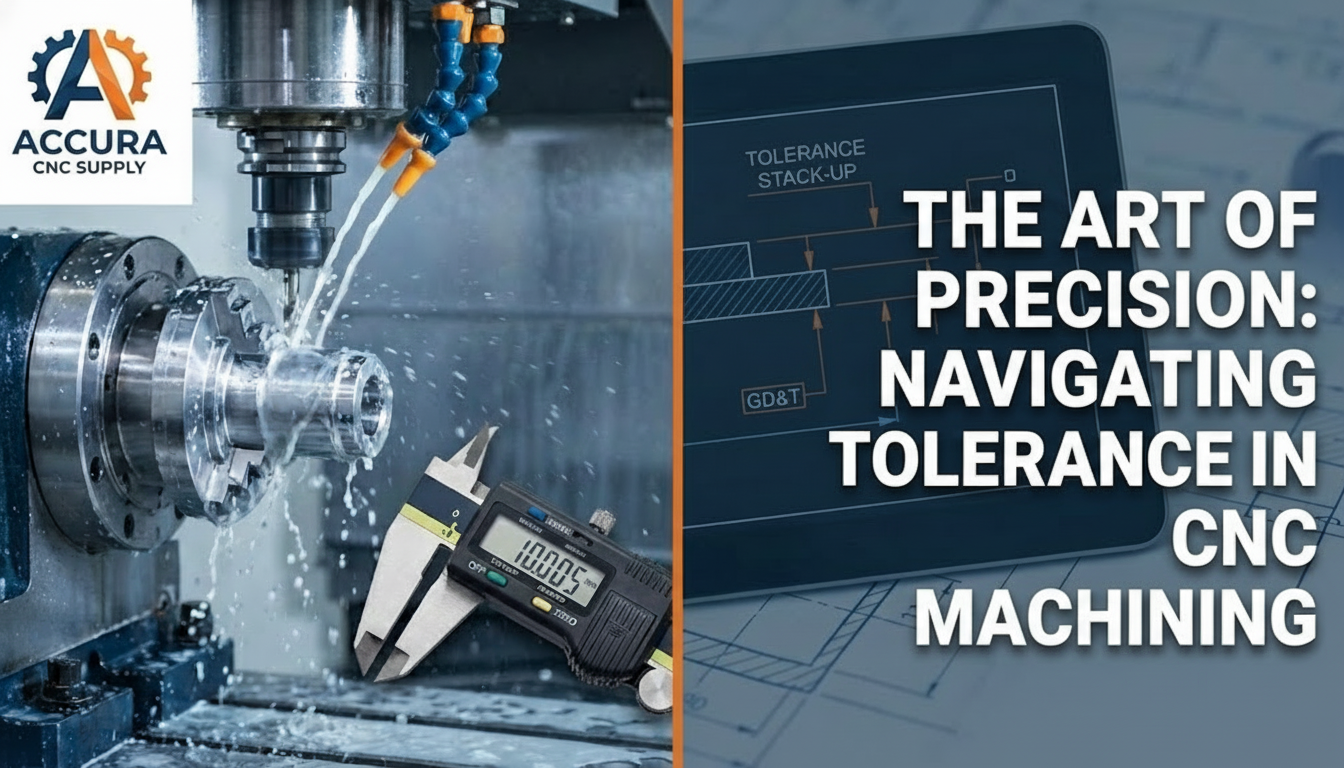
Every physical dimension has an allowable range of variation. No machine, regardless of quality, produces identical measurements every single time. A part designed at 10.00mm wide with a ±0.05mm tolerance passes inspection anywhere from 9.95mm to 10.05mm.
This seems straightforward until parts start working together.
How Tolerance Stack-Up Impacts Mechanical Assembly Quality
Picture five parts bolted in sequence. If each sits at its maximum allowable deviation (+0.05mm), your final assembly lands 0.25mm out of alignment. The consequences cascade quickly:
Mechanical interference causing binding or premature wear
Vibration that shortens component life
Seal failures in fluid or pressure systems
Smart engineers combat this through statistical tolerancing methods and careful consideration of assembly sequence—ensuring the most critical interfaces get the tightest specs while less critical dimensions absorb variation.
The Impact of Material Selection on Achievable Machining Precision
Your material choice directly constrains achievable tolerances:
Aluminum (6061) machines beautifully but has a high thermal expansion coefficient. Temperature swings in your shop can shift dimensions during long operations.
Stainless Steel (304/316) demands premium tooling and slower feeds. The tradeoff is dimensional stability and corrosion resistance.
Engineering Plastics (PEEK, Delrin) can deform under clamping pressure and tool forces, making ultra-tight tolerances harder to hold consistently.
The Real Cost of "Just Make It Tighter"
Here's what many engineers learn the hard way: over-specifying tolerances doesn't just increase cost—it can actually decrease quality.
Tighter tolerances mean slower spindle speeds, more frequent tool changes, and additional inspection steps. Each intervention introduces its own variability. The sweet spot is the loosest tolerance that still guarantees function. This requires understanding how your part actually performs in assembly, not just what looks impressive on a drawing.
Equipping Your Shop for Precision
Achieving consistent tolerances starts with the right equipment. At Accura CNC Supply, we help manufacturers select and implement CNC routers, laser systems, and cutting equipment matched to their precision requirements—backed by installation, training, and ongoing support.
Whether you're upgrading an existing operation or building capability from scratch, we can help you spec equipment that meets your tolerance demands without overspending on capability you won't use.
Let's Talk About Your Requirements
Reach out for a consultation. Email [email protected]—we typically respond within 24 hours.
Ready to get started?
Browse our equipment inventory or get in touch with our team for expert advice on your next project.