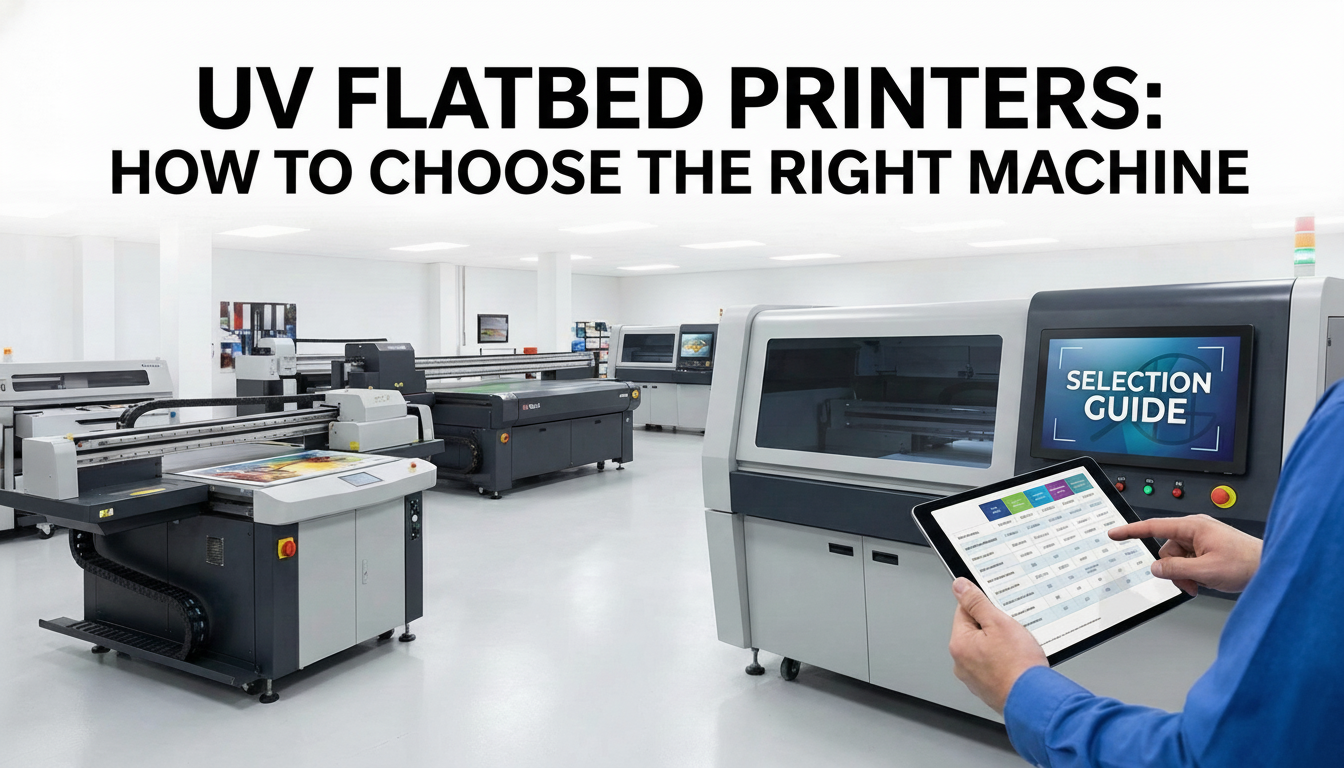
Expert guide to selecting the right UV flatbed printer for your business. Compare key specifications, features, and considerations for making the best choice.
Choosing the Right UV Flatbed Printer
Selecting a UV flatbed printer is a significant investment that will shape your production capabilities for years. The right choice depends on understanding your current needs, growth plans, and how different specifications translate to real-world performance.
Assess Your Production Requirements
Before comparing machines, clearly define what you need:
What Will You Print?
- Primary applications (signage, promotional items, industrial)
- Material types you'll use most often
- Maximum material thickness required
- Quality expectations for your market
How Much Will You Print?
- Expected daily/weekly volume
- Typical job sizes and run lengths
- Peak capacity needs
- Growth projections over 3-5 years
Key Specifications to Evaluate
Print Area Size
The flatbed size determines your maximum single-piece print capability:
- Small format (under 2' x 3'): Promotional products, small signs, prototypes
- Medium format (4' x 4' to 4' x 8'): Standard signage, displays, architectural panels
- Large format (5' x 10' and up): Full-sheet printing, high-volume production
Print Height Clearance
Maximum material thickness matters for specialty applications:
- Standard: 2-3 inches handles most substrates
- Extended: 4-6 inches for thick materials and assembled products
Print Speed
Speed specifications require context:
- Manufacturers quote maximum speeds at lowest quality
- Production speed at acceptable quality matters more
- Compare speeds at similar quality settings
- More print heads generally mean faster output
Resolution and Quality
Resolution affects detail capability:
- 720 DPI: Good for viewing distance signage
- 1080 DPI: Standard for most commercial work
- 1440 DPI: High detail for close-viewing applications
Ink System Considerations
Ink Channels
Standard configurations include:
- CMYK: Basic color printing
- CMYK + White: Essential for dark and clear substrates
- CMYK + White + Varnish: Adds gloss/matte finish options
White Ink Performance
White ink capability is crucial for many applications:
- Opacity and coverage quality vary between machines
- Recirculating systems prevent settling
- White ink costs more and requires more maintenance
Build Quality and Reliability
Frame Construction
- Steel frames offer maximum stability
- Cast aluminum provides good rigidity with less weight
- Welded construction outperforms bolted assemblies
Motion System
- Linear rails and precision bearings affect accuracy
- Servo motors offer better performance than steppers
- Quality components reduce maintenance needs
Support and Service Factors
Technical Support
- Response time for service calls
- Remote diagnostics capability
- Local vs. regional technician coverage
Training
- Initial operator training included
- Ongoing education opportunities
- Online resources and documentation
Making Your Decision
Create a Comparison Matrix
List your must-have features and nice-to-have options. Score each machine against your criteria objectively.
Request Demonstrations
See machines running your actual materials and job types. Bring samples for test prints.
Talk to Current Users
Ask for references and speak with businesses using the machines you're considering.
Get Expert Guidance
Choosing the right UV flatbed printer requires balancing many factors. Contact our team to discuss your specific requirements.
Browse our UV flatbed printer inventory to see available options.
Ready to get started?
Browse our equipment inventory or get in touch with our team for expert advice on your next project.